
Eirini Liotou
eliotou@hua.gr
My name is Eirini Liotou and I am an Assistant Professor at the Department of Informatics & Telematics, Harokopio University of Athens.
My research field is "Design and Management of Software-Defined Networks". My research interests include software-defined and intelligent networks, 6G networks, AI-driven network management, connected and software-defined vehicles, V2X communications, and Quality of Service/Experience (QoS/QoE).
Member of the Intelligent Computer Systems and Applications (ICSA) Research Group.
Short bio
I hold a PhD degree from the Department of Informatics and Telecommunications, National and Kapodistrian University of Athens since 2017. I obtained the MSc in Informatics and Telecommunications from the National and Kapodistrian University of Athens (2011) and the MSc in Communications and Signal Processing from the Imperial College of London (2012). I received the Diploma in Electrical and Computer Engineering from the National Technical University of Athens (2006). Between 2017-2021 I was working as a Post-Doc researcher in the Communication Networks Laboratory of the Department of Informatics and Telecommunications in the National and Kapodistrian University of Athens. I have worked as Software Engineer in Siemens AG and as Senior Software Engineer in Siemens Enterprise Communications in the R&D department for the SME business sector, where I had joined the UC Call Processing team involved in the development activities in the areas of call control features, VoIP signaling protocols and UI programming of high-end telephones. Between 2021-2023, I have been working as a Project Manager / Senior Researcher for EU Research Projects at the I-SENSE group of the Institute of Communications and Computer Systems (ICCS), serving as Deputy Project Coordinator of EU projects (5G-IANA, XGain). I am an author of peer-reviewed publications in conferences and high-impact journals, while I have served as Technical Program Committee member and Technical Reviewer in flagship IEEE conferences and international journals. During my PhD, I have visited Vodafone R&D Technology, UK, and the University of Duisburg-Essen, Germany. I have participated in various EU projects (CROSSFIRE, SMART-NRG, CASPER, etc.), national projects (RECENT, CityZen, etc.) and COST actions (QUALINET, ACROSS, IRACON). I have also served as Adjunct Teaching Staff at the National and Kapodistrian University of Athens (2013-21), Hellenic Open University (2020-21), and Business College of Athens (2015-16). I also serve as a Reviewer for EU projects (as an EC expert).
My CV is available here (in Greek).
My main research interests revolve around 5G/6G mobile cellular networks, with a particular focus on:
- Software-Defined Networking (SDN)
- Software-Defined Vehicle (SDV)
- Network Functions Virtualization (NFV)
- Management and Orchestration (MANO)
- Vertical Application Enabling Architectures
- Artificial Intelligence (AI) in 6G networks
- Device-to-Device (D2D) communications
- Quality of Experience (QoE)
- Radio Resource Management
- HTTP Adaptive Video Streaming
- Federated Learning
- Cooperative, connected and automated mobility (CCAM)
- Vehicular Ad-Hoc Networks (VANETs)
- V2X communications
- Smart campus applications
Education
Post Doc, User-centric network and service management for immersive applications, 2019-2021Scholarship for Post-doc research from the State Scholarship Foundation ("ΙΚΥ")
Department of Informatics & Telecommunications
NATIONAL & KAPODISTRIAN UNIVERSITY OF ATHENS
PhD, Quality of experience characterization and provisioning in mobile cellular networks, 2017
Department of Informatics & Telecommunications
NATIONAL & KAPODISTRIAN UNIVERSITY OF ATHENS
PhD thesis available here
MSc. in Communications & Signal Processing, 2012
Department of Electrical & Electronic Engineering
IMPERIAL COLLEGE LONDON
Dissertation: "A cognitive packet protocol for opportunistic communications" available here
MSc. in New Technologies of Informatics & Telecommunications, 2011
Department of Informatics & Telecommunications
NATIONAL & KAPODISTRIAN UNIVERSITY OF ATHENS
Dissertation: "A graph coloring based secondary resource allocation for spatial spectrum reuse" available here
Diploma in Electrical & Computer Engineering (MEng equivalent), 2006
Department of Electrical & Computer Engineering
NATIONAL TECHNICAL UNIVERSITY OF ATHENS
Dissertation: "Study and measurement of the interferences caused by the aeronautical mobile satellite networks to the fixed microwave network" available here
Publications
Journal papers
1. E. Liotou, D. Tsolkas, N. Passas, and L. Merakos, “Quality of Experience management in mobile cellular networks: Key issues and design challenges,” IEEE Communications Magazine, Network & Service Management Series, vol. 53, no. 7, pp. 145-153, July 2015. (Impact Factor: 9.27)
2. D. C. Mocanu, J. Pokhrel, J. P. Garella, J. Seppӓnen, E. Liotou, and M. Narwaria, “No-reference video quality measurement: Added value of machine learning,” Journal of Electronic Imaging, vol. 24, no. 6, December 2015. (Impact factor: 0.816)
3. F. Metzger, E. Liotou, C. Moldovan, and T. Hoßfeld, “TCP video streaming and mobile networks: Not a love story, but better with context,” Elsevier Computer Networks, Special Issue on “Traffic and Performance in the Big Data Era,” vol. 109, pp. 246-256, November 2016. (Impact Factor: 2.522)
4. D. Tsolkas, E. Liotou, N. Passas, and L. Merakos, “A survey on parametric QoE estimation for popular services,” Elsevier Journal of Network and Computer Applications, vol. 77, pp. 1-17, January 2017. (Impact Factor: 3.991)
5. E. Liotou, K. Samdanis, E. Pateromichelakis, N. Passas, and L. Merakos, “QoE-SDN APP: A rate-guided QoE-aware SDN-APP for HTTP adaptive video streaming,” IEEE Journal on Selected Areas in Communications, Series on Network Softwarization & Enablers, vol. 36, no. 3, pp. 598-615, March 2018. (Impact Factor: 7.172)
6. E. Liotou, D. Tsolkas, G. Kalpaktsoglou, S. Tennina, L. Pomante, and N. Passas, "The CASPER user-centric approach for advanced service provisioning in mobile networks," Elsevier Microprocessors and Microsystems, vol. 77, September 2020.
7. K. V. Katsaros, E. Liotou, F. Moscatelli, T. Rokkas, G. Drainakis, E. Bonetto, D. Brevi, D. Klonidis, I. Neokosmidis, and A. Amditis, "Enabling far-edge intelligent services with NetApps: the Automotive Case," IEEE Internet of Things Magazine - Network Application Software for Vertical IoT Industry special issue, December 2022.
8. E. Liotou, D. Xenakis, V. Georgara, G. Kourouniotis, and L. Merakos, "Cache-enabled adaptive video streaming: A QoE-based evaluation study", MPDI Future Internet, Quality of Experience (QoE) Management in Softwarized Network Environments special issue, June 2023.
9. N. Baganal-Krishna, R. Lubben, E. Liotou, K. Katsaros, A. Rizk, “A Federated Learning Approach to QoS Forecasting in Cellular Vehicular Communications: Approaches and Empirical Evidence”, Elsevier Computer Networks, February 2023.
10. D. Georgiadis, K. Karathanasopoulou, E. Liotou, G. Dimitrakopoulos, “LoRaWAN-based Emergency Framework for Vehicular Networks”, IEEE Networking Letters, June 2025.
11. M. Xevgenis, M. Polychronaki, D. Kogias, H. Leligkou, and E. Liotou, “Securing Zero-Touch Networks with Blockchain: Decentralized Identity Management and Oracle-Assisted Monitoring”, MDPI Electronics, 15(2), 266, January 2026.
12. C. Chatzieleutheriou, and E. Liotou, “A Survey on AI for 6G: Challenges and Opportunities”, IEEE Open Journal of the Communications Society, March 2026
13. F. Antonopoulos, and E. Liotou, “An SDN-Enabled Vehicular Networking Platform for Mobility-Aware QoS and Handover Evaluation”, MDPI Applied Sciences, April 2026.
Conference proceedings
1. D. Tsolkas, E. Liotou, N. Passas, and L. Merakos, “A graph-coloring secondary resource allocation for D2D communications in LTE networks,” 17th International Workshop on Computer Aided Modeling and Design of Communication Links and Networks (IEEE CAMAD), Barcelona, Spain, September 2012.
2. D. Tsolkas, E. Liotou, N. Passas, and L. Merakos, “Enabling D2D communications in LTE networks,” 24th International Symposium on Personal, Indoor and Mobile Radio Communications (IEEE PIMRC), London, United Kingdom, September 2013.
3. E. Liotou, E. Papadomichelakis, N. Passas, and L. Merakos, “Quality of Experience-centric management in LTE-A mobile networks: The Device-to-Device communication paradigm,” 6th International Workshop on Quality of Multimedia Experience (IEEE QoMEX), Singapore, September 2014.
4. E. Liotou, D. Tsolkas, N. Passas, and L. Merakos, “Ant Colony Optimization for resource sharing among D2D communications,” 19th International Workshop on Computer Aided Modeling and Design of Communication Links and Networks (IEEE CAMAD), Athens, Greece, December 2014.
5. E. Liotou, G. Tseliou, K. Samdanis, D. Tsolkas, F. Adelantado, and C. Verikoukis, “An SDN QoE-Service for dynamically enhancing the performance of OTT applications,” 7th International Workshop on Quality of Multimedia Experience (IEEE QoMEX), Costa Navarino, Greece, May 2015.
6. E. Liotou, H. Elshaer, R. Schatz, R. Irmer, M. Dohler, N. Passas, and L. Merakos, “Shaping QoE in the 5G ecosystem,” 7th International Workshop on Quality of Multimedia Experience (IEEE QoMEX), Costa Navarino, Greece, May 2015.
7. D. Tsolkas, E. Liotou, N. Passas, and L. Merakos, “Addressing traffic demanding scenarios in cellular networks through QoE-based rate adaptation,” 26th International Symposium on Personal, Indoor and Mobile Radio Communications (IEEE PIMRC), Hong Kong, China, August 2015.
8. E. Liotou, T. Hoßfeld, C. Moldovan, F. Metzger, D. Tsolkas, and N. Passas, “Enriching HTTP adaptive streaming with context awareness: A tunnel case study,” International Conference of Communications (IEEE ICC), Kuala Lumpur, Malaysia, May 2016.
9. E. Liotou, D. Tsolkas, and N. Passas, “A roadmap on QoE metrics and models,” 23rd International Conference of Telecommunications (IEEE ICT), Thessaloniki, Greece, May 2016.
10. E. Liotou, D. Tsolkas, K. Samdanis, N. Passas, and L. Merakos, “Towards Quality of Experience management in the next generation of mobile networks,” 25th European Conference on Networks and Communications (EuCNC), Athens, Greece, June 2016.
11. E. Liotou, R. Schatz, A. Sackl, P. Casas, D. Tsolkas, N. Passas, and L. Merakos, “The beauty of consistency in radio-scheduling decisions,” 59th Global Communications Conference (IEEE Globecom Wkshps) - International Workshop on Quality of Experience for Multimedia Communications (QoEMC), Washington, DC, USA, December 2016.
12. E. Liotou, A. Sfikopoulos, P. Kaltzias, and V. Tsolkas, “An evaluation of buffer- and rate-based HTTP adaptive streaming strategies,” 22nd International Workshop on Computer Aided Modelling and Design of Communication Links and Networks (IEEE CAMAD), Lund, Sweden, June 2017.
13. S. Tennina, I. Tunaru, G. Karopoulos, D. Xenakis, E. Liotou, and N. Passas, “Secure energy management in smart energy networks,” 22nd International Workshop on Computer Aided Modelling and Design of Communication Links and Networks (IEEE CAMAD), Lund, Sweden, June 2017.
14. E. Liotou, A. Marotta, L. Pomante, and K. Ramantas, “A middleware architecture for QoE provisioning in mobile networks,” 22nd International Workshop on Computer Aided Modelling and Design of Communication Links and Networks (IEEE CAMAD), Lund, Sweden, June 2017.
15. M.-E. Xezonaki, E. Liotou, N. Passas, and L. Merakos, “An SDN QoE monitoring framework for VoIP and video applications,” 19th International Symposium on a World of Wireless, Mobile and Multimedia Networks (IEEE WoWMoM), Chania, Greece, June 2018.
16. E. Liotou, D. Tsolkas, S. Tennina, L. Pomante, G. Kalpaktsoglou, and N. Passas, “The CASPER project approach towards user-centric mobile networks,” Euromicro Conference on Digital System Design (DSD), Chalkidiki, Greece, August 2019.
17. E. Liotou, K. Chatzieleftheriou, G. Christodoulou, N. Passas, and L. Merakos, "Emulation of HTTP Adaptive Video Streaming over SDN," IEEE International Mediterranean Conference on Communications and Networking (Meditcom), Athens, Greece, September 2021.
18. E. Liotou, A. Alexiou, N. Passas, and L. Merakos, "QoE-centric implementation of SDN platform for Open-Flow-based network path selection," IEEE International Mediterranean Conference on Communications and Networking (Meditcom), Athens, Greece, September 2021.
19. F. Moscatelli, T. Xirofotos, A. Rizk, N. Baganal-Krishna, E. Bonetto, E. Liotou, and A. Amditis, "The 5G-IANA platform: Bringing far-edge resources and ML potential to the disposal of automotive third parties," IEEE Future Networks World Forum (FNWF), Montreal, Canada, October 2022.
20. G. Rizzo, E. Liotou, Y. Maret, J.-F. Wagen, T. Zugno, M. Wu, and A. Kliks, "Towards AI-Native Vehicular Communications," VTC-Spring2023, Florence, June 2023.
21. E. Liotou, D. Klonidis, M. Andolfi, P. Schmitting, E. Bonetto, M. Wimmer, K. Katsaros, C. Ververidis, "The 5G-IANA Automotive Open Experimentation Platform: Features and Assets at the Disposal of Third Parties,"IEEE Future Networks World Forum (FNWF), Baltimore, November 2023.
22. G. Scivoletto, M. Andolfi, E. Liotou, K. Katsaros, F. Princiotto, E. Bonetto, D. Brevi, T. Xirofotos, G. Landi, M. Fuentes, M. Ortiz, R. Horvath, M. Wimmer, “Development & Reliable Orchestration of Network Applications for the Automotive Domain Across the Edge-To-Cloud Continuum”, EuCNC & 6G Summit, Antwerp, June 2024.
23. P. Mashhadi, and E. Liotou, “Enhancing immersive telepresence through super-resolution for adaptive streaming”, ACM SIGCOMM Workshop on Emerging Multimedia Systems (EMS), Coimbra, September 2025.
24. G. Christodoulou, and E. Liotou, “Towards QoS-aware software-defined architectures for real-time vehicular networks in 6G-enabled environments”, IEEE Conference on Network Function Virtualization and Software Defined Networks (NFV-SDN), Athens, November 2025.
25. K. Gyftodimos, K. Chiotis, E. Politi, G. Dimitrakopoulos, and E. Liotou, “Temporal transformer CAN encoder with federated lightweight heads for anomaly detection”, ITS European Congress, Istanbul, April 2026.
26. S. Stratis, and E. Liotou, “Study of Perception in Vehicle Platoons: Balancing Communication Overhead and Information Accuracy”, International Conference on Telecommunications (ICT), Thessaloniki, May 2026.
27. C. Chatzieleutheriou, and E. Liotou, “Agentic Routing and VNF Placement”, International Conference on Telecommunications (ICT), Thessaloniki, May 2026.
28. A. Stefanidou, D. Georgiadis, K. Karathanasopoulou, E. Politi, E. Liotou, and G. Dimitrakopoulos, “Edge-Optimized Fisheye Sensing for UAV-Assisted Connected Mobility”, International Conference on Telecommunications (ICT), Thessaloniki, May 2026.
29. P. Flegkas, K. Konsoulas, E. Liotou, “6G-NOW: A Network-of-Networks Architecture for Resilient Connected and Automated Mobility”, International Conference on Telecommunications (ICT), Thessaloniki, May 2026.
30. O. Kritsotakis, and E. Liotou, “An AI-Enabled Decision Support System for Predictive QoS Management in Autonomous Vehicular Networks”, IEEE Conference in Electronic Engineering & Information Technology (EEITE), Chania, June 2026.
31. A. Georgis, T. Manoli, and E. Liotou, “A BitTorrent Peer-to-Peer Simulation Framework in the NS-3 Network Simulator”, 9th Conference on Cloud and Internet of Things (CIoT), Athens, November 2026.
32. T. Manoli, and E. Liotou, “Deep Learning-based Physical Layer Design: Integrating Intelligent Channel Estimation and Beamforming”, 9th Conference on Cloud and Internet of Things (CIoT), Athens, November 2026.
33. K. Gyftodimos, E. Liotou, K. Chiotis, and G. Dimitrakopoulos, “A physics-grounded synthetic dataset and ML simulation framework for QoS-aware AI inference offloading in connected vehicles”, IEEE International Conference on Cloud Networking (CloudNet), Athens, October 2026.
34. K. Konsoulas, A. Bakas, P. Flegkas, N. Moraitis, E. Liotou, G. Dimitrakopoulos, P. Basaras, V. Pitsilis, D. Uzunidis, and H. Koumaras, “The 6G-NOW Approach: Design and Experimental Evaluation of a D2D-Aware ATSSS Architecture for NTN-Backhauled 5G Networks”, IEEE International Conference on Cloud Networking (CloudNet), Athens, October 2026.
35. C. Chatzieleutheriou, and E. Liotou, “Heuristic Policies for Joint SDN Routing and VNF Placement”, IEEE International Conference on Cloud Networking (CloudNet), Athens, October 2026.
36. K. Gyftodimos, E. Liotou, K. Chiotis, E. Politi, and G. Dimitrakopoulos, “A Physics-Grounded Benchmark for Risk-Aware Perception Offloading in Software-Defined Vehicles”, IEEE Conference on Network Function Virtualization and Software Defined Networks (NFV-SDN), Tokyo, November 2026.
37. M. Karner, M. Driussi, E. Liotou, G. Mitjàa, S. Boulay, A. Validi, E. Arnautovic, G. Stieglbauer, L. A. Nava, C. Martinez, and A. Snel, “Shift2SDV: A Reference Architecture for the Software-Defined Vehicle Transition”, IEEE Conference on Network Function Virtualization and Software Defined Networks (NFV-SDN), Tokyo, November 2026.
38. N. Moraitis, E. Liotou, G. Dimitrakopoulos, K. Konsoulas, and P. Flegkas, “A Software-Defined D2D-Aware ATSSS Architecture with Predictive Traffic Steering for Connected Vehicles”, IEEE Conference on Network Function Virtualization and Software Defined Networks (NFV-SDN), Tokyo, November 2026.
Book chapters / Lecture Notes in Computer Science
1. D. Tsolkas, E. Liotou, N. Passas, and L. Merakos, “LTE-A access, core, and protocol architecture for D2D communication,” Smart Device to Smart Device Communication, Springer International Publishing, Editors: S. Mumtaz and J. Rodriguez, ISBN: 978-3-319-04963-2, pp. 23-40, April 2014.
2. D. Tsolkas, E. Liotou, N. Passas, and L. Merakos, “The need for QoE-driven interference management in femtocell-overlaid cellular networks,” Mobile and Ubiquitous Systems: Computing, Networking, and Services, Springer International Publishing, Editors: I. Stojmenovic, Z. Cheng, and S. Guo, ISBN: 978-3-319-11569-6, vol. 131, pp. 588-601, September 2014 (Mobiquitous, Tokyo, Japan, December 2013).
3. F. Metzger, T. Hoßfeld, L. Skorin-Kapov, Y. Haddad, E. Liotou, P. Pocta, H. Melvin, V. Siris, A. Zgank, and M. Jarschel, “Context monitoring for improved system performance and QoE,” Autonomous Control for a Reliable Internet of Services: Methods, Models, Approaches, Techniques, Algorithms and Tools, Springer International Publishing, Editors: I. Ganchev, R. van der Mei, and J. L. van den Berg, ISBN: 978-3-319-90415-3, vol. 10768, pp. 23-48, May 2018.
4. R. Schatz, S. Schwarzmann, T. Zinner, O. Dobrijevic, E. Liotou, P. Pocta, S. Barakovic, J. Barakovic Husic, and L. Skorin-Kapov, “QoE management for future networks,” Autonomous Control for a Reliable Internet of Services: Methods, Models, Approaches, Techniques, Algorithms and Tools, Springer International Publishing, Editors: I. Ganchev, R. van der Mei, and J. L. van den Berg, ISBN: 978-3-319-90415-3, vol. 10768, pp. 49-80, May 2018.
5. E. Liotou, T. Hoßfeld, C. Moldovan, F. Metzger, D. Tsolkas, and N. Passas, "The value of context-awareness in bandwidth-challenging HTTP Adaptive Streaming scenarios,” Autonomous Control for a Reliable Internet of Services: Methods, Models, Approaches, Techniques, Algorithms and Tools, Springer International Publishing, Editors: I. Ganchev, R. van der Mei, and J. L. van den Berg, ISBN: 978-3-319-90415-3, vol. 10768, pp. 128-150, May 2018.
White papers
1. Co-author in the QUALINET White Paper “Definitions of Immersive Media Experience (IMEx)”, arXiv preprint arXiv:2007.07032, June 2020.
2. Co-author in the 5G Infrastructure Association White Paper “Business Validation in 5G PPP vertical use cases”, June 2020.
3. Co-author in the White Paper “From 5G to 6G Vision - A Connected and Automated Mobility (CAM) perspective” by the 5G for CAM Working Group of the 6G-IA, June 2022.
4. Co-author in the White Paper “Network Applications: Opening up 5G and Beyond networks” by the 5G-PPP Software Network Working Group, July 2023.
5. Co-author in the White Paper “5G PPP in Review”, by the 5G-PPP Steering Board / Technology Board, November 2023.
6. Co-author in the White Paper “6G Technology Overview,” 6th ed., one6G Association, September 2026.
7. Co-author in the White Paper “Agentic AI and Foundation Models in Mobile Communication Systems,” one6G Association, September 2026.
Other publications
1. E. Liotou, N. Passas, and L. Merakos, “Towards QoE provisioning in next generation cellular networks,” IEEE Communications Society, Multimedia Communications Technical Committee E-Letter, Special Issue on “QoE Management for Next Generation Multimedia Services”, vol. 10, no. 3, May 2015 (invited article).
2. E. Liotou, N. Passas, and L. Merakos, “The emergence of experience packages in the 5G era,” IEEE 5G Tech Focus, vol. 1, no. 3, September 2017 September 2017 (editor-reviewed).
Courses
Computer Networks, 2nd semester, BSc
- Introduction to Computer Networks and the Internet: Internet principles and architecture, basic network performance metrics (delay, loss, throughput), packet and circuit switching, protocol layers and service models, encapsulation, and introductory concepts of network security.
- Network and Transport Layers: IP addressing (IPv4, IPv6), DHCP, NAT, routers and forwarding, routing algorithms and protocols (OSPF, BGP), transport services, multiplexing/demultiplexing, UDP, reliable data transfer principles, TCP and congestion control.
- Link Layer and LAN Technologies: Error detection and correction techniques, multiple access protocols, local area network addressing, and ARP protocol.>
Internet Technologies, 5th semester, BSc
- Introduction to Computer Networks and the Internet: Internet principles and architecture, basic network performance metrics (types of delay, packet loss, throughput, etc.), packet and circuit switching, protocol layers, encapsulation, network security basics
- Application layer: Principles of network applications, web architecture, HTTP protocol, FTP, web caching, cookies, e-mail (SMTP, POP3, IMAP), Domain Name System (DNS), P2P file sharing
- Quality of Experience (QoE): Quality of Service and Experience, Internet service evaluation models, network management systems based on QoE
- Multimedia Networking: Multimedia Network Applications, UDP streaming, HTTP adaptive streaming, Peer-to-Peer file distribution, Content Distribution Networks (CDN), DASH, NetFlix, YouTube, Voice over IP (VoIP), SIP, RTP protocols, multiple classes of service, unified and differentiated services (Diffserv, IntServ), QoS, Resource Reservation Protocol (RSVP)
Management of Software Defined Networks, 8th semester, BSc
- Wireshark lab (hands on protocols): HTTP, DNS, ICMP, ARP, IP, DHCP, ΝΑΤ
- Mininet (SDN) lab: POX SDN controller, Open VSwitch, Ryu Controller, MiniNAM
Management of Softwarized Edge and Cloud Networks, MSc
- Software-Defined and Virtualized Networks: Principles and architectures of Software-Defined Networking (SDN), control and data plane separation, SDN controllers and applications, Network Functions Virtualization (NFV), and practical SDN lab exercises.
- Wireless, Mobile, and Edge Networking: 5G networks, Wi-Fi technologies and virtualization, mobile cloud networking, edge computing architectures, and integration with cloud infrastructures.
- IoT and Quality of Experience: Internet of Things (IoT) architectures and protocols, Cloud and Fog computing for IoT, LoRa technology for low-power wide-area networks, and QoE principles for service optimization and network management.
Computing and Networking Infrastructures I & II, MSc
- Foundations of Computer Networks: Internet architecture and principles, network performance metrics (delay, loss, throughput), packet and circuit switching, protocol layers and service models, encapsulation, and basic network security.
- Network Core and Access: IP addressing (IPv4, IPv6), DHCP, NAT, routing and forwarding, routing algorithms and protocols (OSPF, BGP), SDN, transport protocols (UDP, TCP), congestion control, and link layer technologies (error detection, multiple access, ARP).
- Application Layer and Network Services: Principles of network applications, client-server and P2P architectures, web and HTTP, FTP, web caching, cookies, e-mail protocols (SMTP, POP3, IMAP), DNS, and introduction to Quality of Experience (QoE).
PhD Supervision
-
Gerasimos Christodoulou, "Vehicular Ad Hoc Networks (VANETs) and Internet of Software-Defined Vehicles (ISDV)", October 2024 – present.
-
Konstantina Chatzieleutheriou, "Development and Optimization of 6G Networks using Artificial Intelligence", October 2024 – present.
-
Georgios Boltsis, "AI-Driven Context-Aware Recommendation Systems in 6G Networks", December 2024 – present.
-
Nikolaos Vasilakis, "Large Language Models for Next-Generation Intelligent Networking", March 2026 – present.
Research projects (selected)
July 2025 – March 2028: V2X Comunication Middleware Building Block Leader for HORIZON-JU-Chips "Shift2SDV" (A common Software development framework and hardware independent microservice-oriented middleware architecture for the stepwise migration to the Software Defined Vehicle of the Future)
January 2026 – July 2026: Project Manager for "6GNOW". Research focus: Transformation of the SNS-JU ENVELOPE platform into a network-of-networks environment supporting NR Sidelink and satellite connectivity.
September 2021 – April 2024: Deputy Project Coordinator for H2020-ICT41 (5G PPP Phase 3.VI) “5G-IANA” (5G Intelligent Automotive Network Applications)
July 2022 – December 2023: Deputy Project Coordinator for HORIZON-CL6-2021-COMMUNITIES-01 Project “XGain” (Enhancing Competitiveness, Resilience and Sustainability of Remote Farming, Forestry and Rural Areas through Holistic Assessment of Smart XG, Last-mile and Edge Solutions’ Gains)
September 2018 – October 2019: Experienced researcher for Horizon2020 Marie Curie RISE project “CASPER” (user-Centric middleware Architecture for advanced Service Provisioning in futurE netwoRks)
August 2018 – April 2019: Senior researcher for FP7 Marie Curie “CROSSFIRE” (unCooRdinated netwOrk StrategieS for enhanced interFerence, mobIlity, radio Resource, and Energy saving management in LTE-Advanced networks)
December 2017 – July 2018: Senior researcher for FP7 Marie Curie IAPP “SMART-NRG” (InduStry-acadeMia pArtnership for the design and implementation of an efficient, Reliable and secure smarT eNeRGy network)
Demos & Prototypes
HUAssistant: An Agentic AI Assistant for Smart Campus Management
HUAssistant is an intelligent, privacy-first Smart Campus assistant that combines Agentic AI, Large Language Models (LLMs), real-time IoT data and an interactive Digital Twin. Developed and evaluated on the actual infrastructure of the Department of Informatics and Telematics at Harokopio University, the prototype enables natural-language interaction with live and historical building information collected from 128 IoT devices.
Key Features
- Natural-language and voice interaction with the Smart Campus infrastructure
- Interactive Digital Twin covering all 8 levels of the building
- Real-time monitoring and analysis of 128 physical IoT devices
- Agentic AI workflows for contextual reasoning and multi-sensor analysis
- Detection of occupancy anomalies, energy waste and power outages
- RAG-based access to campus, room, laboratory and faculty information
- Privacy-first, on-premise operation using local open-source LLMs
Technologies: LLMs · Agentic AI · LangGraph · Digital Twin · IoT · RAG · Qdrant · LoRaWAN · Ollama
Developer: Nikolaos Panagiotis Rigas · 2026
SmartBooking: Intelligent Meeting Room Booking and Management
SmartBooking is an intelligent meeting room booking and management system that automatically identifies the best meeting times based on participants' availability and recommends suitable rooms according to capacity and requested amenities. The system operates as an intelligent layer on top of Google Calendar, supporting real-time availability checking, event creation and bidirectional synchronization of events and RSVPs.
Key Features
- Intelligent recommendation of optimal meeting times based on participants' real Google Calendar availability
- Smart room recommendations based on availability, capacity and requested amenities
- Bidirectional synchronization with Google Calendar for events and RSVPs
- Support for recurring meetings and automatic handling of scheduling conflicts
- Personal calendar with automatic event classification into categories such as lectures, labs, meetings and office hours
- Role-based access for users and administrators, including room and booking management
- Secure Google OAuth 2.0 authentication and protection of sensitive data
Technologies: Java · Spring Boot · PostgreSQL · Google Calendar API · OAuth 2.0 · Thymeleaf · Tailwind CSS · FullCalendar · Docker
Developer: Stavroula Parsali · 2026
Software-Defined Vehicle Simulation
Software-Defined Vehicle (SDV) Simulation is a fully functional network emulation environment for studying software-defined vehicular networks. The platform combines SDN-based network control, MQTT-based vehicle telemetry and an interactive real-time monitoring dashboard.
Key Features
- Emulation of multiple Software-Defined Vehicles using Mininet
- Centralized SDN network control through Ryu and OpenFlow 1.3
- Real-time vehicle telemetry exchange using MQTT and Mosquitto
- Autonomous vehicle agents generating speed, position, engine state and battery telemetry
- Realistic electric-vehicle energy consumption model including rolling resistance, aerodynamic drag and regenerative braking
- Real-time monitoring of latency, throughput and exchanged messages
- Interactive vehicle telemetry dashboard with speed, battery level, position and driving status
- Real-time vehicle registry exposed through the Ryu REST API
Technologies: Software-Defined Networking (SDN) · Software-Defined Vehicles (SDV) · Mininet · Ryu · OpenFlow 1.3 · MQTT · Mosquitto · Flask · SocketIO · REST API
Developer: Nikolaos Zapantis · 2026
Evaluation of Virtual Network Functions (VNFs) in Mininet
VNF Evaluation in Mininet is an experimental environment for the implementation and functional evaluation of containerized Virtual Network Functions. The platform combines Mininet, Open vSwitch and Docker to create a reproducible network environment in which multiple VNFs can be deployed, interconnected and evaluated through predefined test scenarios.
Key Features
- Implementation and evaluation of 10 containerized Virtual Network Functions
- Support for Router, Firewall, NAT, DNS, Proxy, IDS, WAF, Load Balancer, Edge Cache and Traffic Control VNFs
- Network emulation using Mininet and Open vSwitch
- Deployment of individual VNFs as independent Docker containers
- Service Function Chaining across multiple network functions
- Predefined test scenarios for connectivity, security rules, traffic processing and VNF functionality
- Web dashboard for executing test scenarios and visualizing their results
- Monitoring of Docker containers and experimental infrastructure using Prometheus, Grafana and cAdvisor
Technologies: SDN · NFV · Mininet · Open vSwitch · Docker · Service Function Chaining · Prometheus · Grafana · cAdvisor
Developer: Kleon Kola · 2026
AgenticSimulator: Simulation of Multi-Agent Applications on Edge/Cloud Infrastructures
AgenticSimulator is a discrete-event simulation framework for evaluating LLM-based agentic systems deployed across edge and cloud infrastructures. It combines infrastructure-level simulation of CPU sharing, pod queues and resource contention with agent-level modeling of LLM inference, tool calls, routing decisions and workflow execution, enabling controlled experimentation with complex multi-agent applications.
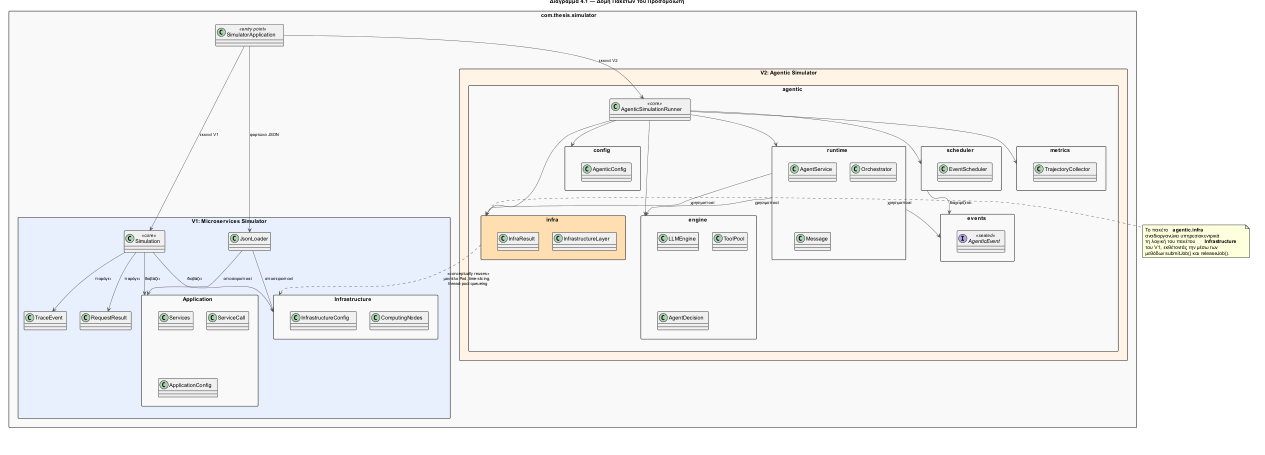
Key Features
- Discrete-event simulation of LLM-based agentic workflows
- Two-layer architecture combining infrastructure and agentic behavior
- CPU time-sharing, pod queuing and resource contention modeling
- Stochastic modeling of LLM inference and external tool calls
- Monte Carlo routing decisions and token/step execution budgets
- Support for multiple agents, workloads, compute nodes and deployment zones
- Edge versus cloud agent placement experimentation
- Fully parameterized simulation scenarios through JSON configuration files
Technologies: Java 21 · Spring Boot · Maven · Discrete-Event Simulation · Agentic AI · LLMs · Edge/Cloud Computing · Kubernetes · JSON · Jackson
Developer: Ioannis Leounakis · 2026
UniBuddy: Real-Time Campus Social Application
UniBuddy is a real-time campus social application designed to facilitate spontaneous social interaction and collaboration within the university community. The application automatically detects when users are present on campus through WiFi and enables them to discover and communicate with other users who are there at the same time, without relying on continuous GPS tracking or revealing precise location coordinates.
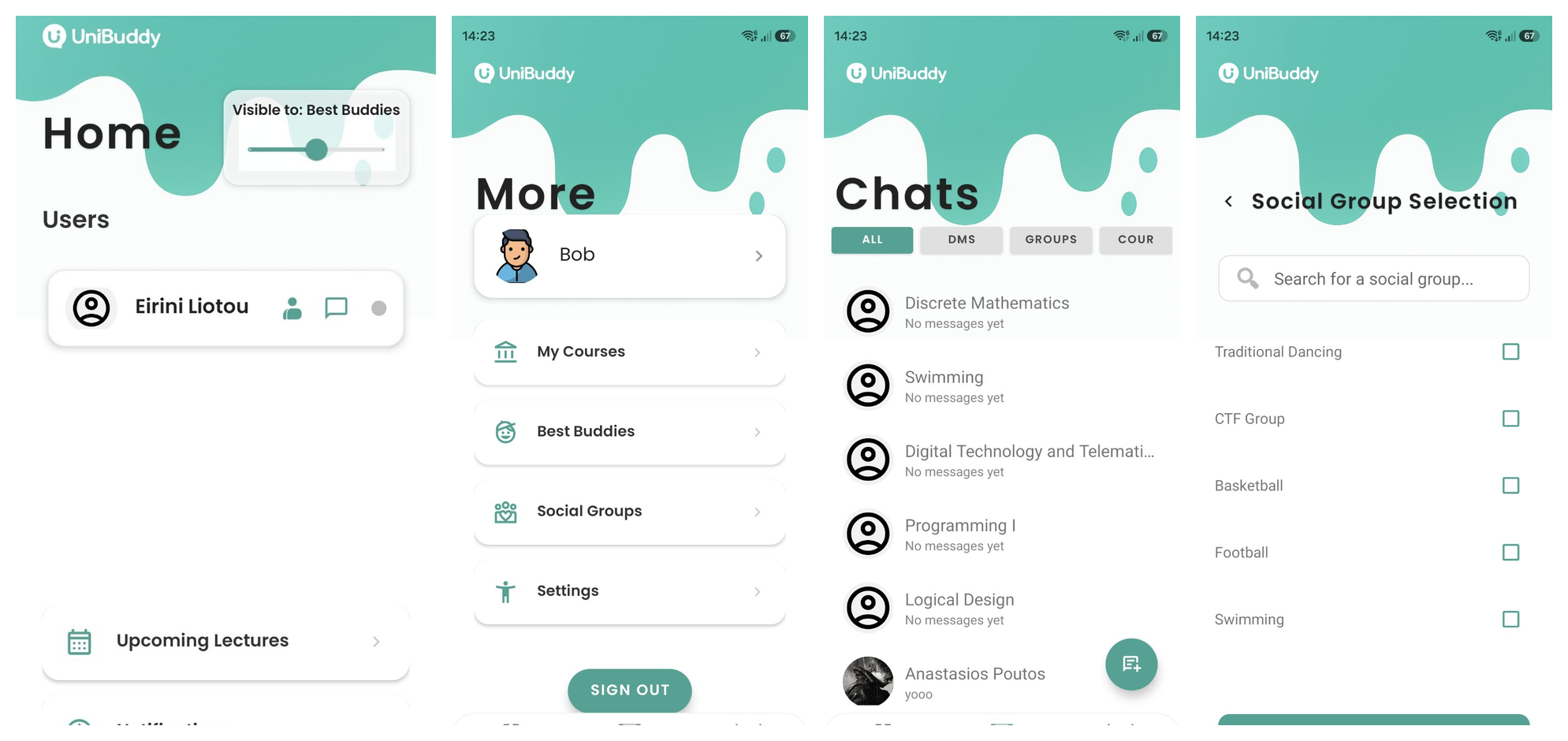
Key Features
- Automatic campus presence detection through WiFi without continuous GPS tracking
- Real-time discovery of users currently present on campus
- Privacy-aware visibility control with None, Best Buddies and All options
- Direct, group and course-based real-time chats
- Best Buddies contact management and user profile discovery
- Push notifications for messages and friends becoming active
- Course management, lecture schedules and upcoming lecture reminders
- Google account authentication and personalized user profiles
Technologies: Android · Kotlin · WiFi-based Presence Detection · Firebase · Firebase Realtime Database · Firebase Cloud Messaging · Volley
Developer: Anastasios Poutos · 2026
SmartClassroomAssistant
SmartClassroomAssistant is an Android application developed for Smart Campus environments, providing real-time monitoring of classroom environmental conditions and personalized notifications for university staff. The application integrates IoT sensor data with cloud services to support professors and administrators in monitoring classrooms, managing schedules and receiving alerts related to teaching conditions.
Key Features
- Real-time monitoring of classroom temperature, CO₂ and humidity
- Integration with IoT sensors through ThingsBoard and MQTT
- Firebase-based authentication, realtime database and push notifications
- Personalized teaching schedules and classroom information for professors
- Automatic environmental alerts based on classroom sensor measurements
- Meeting and notification management
- Administrative management of users, roles, IoT devices and alert rules
- Cloud-based communication between ThingsBoard, Firebase and the Android application
Technologies: Android · Java · Android Studio · IoT · ThingsBoard · MQTT · Firebase · Firebase Authentication · Realtime Database · Firebase Cloud Messaging
Developer: Christina Bachou · 2025
Smart Personalized Student Timetable
Smart Personalized Student Timetable is a web application that enables university students to automatically build and maintain their personal academic timetable. The system adapts course availability to each student's year of study and completed courses, detects scheduling conflicts, incorporates academic calendar changes and synchronizes the resulting timetable with Google Calendar.

Key Features
- Personalized course selection based on year of study and previously completed courses
- Automatic detection of timetable conflicts during course selection
- Interactive weekly timetable generation
- Integration of semester boundaries, holidays and academic calendar changes
- Automatic synchronization of lectures with Google Calendar
- Recurring calendar events with automatic exceptions for holidays and cancelled lectures
- Administrative interface for importing official timetables and academic calendars from PDF documents
- Secure user authentication and data isolation through row-level security
Technologies: React · TypeScript · Supabase · PostgreSQL · Google OAuth 2.0 · Google Calendar API · Serverless Functions · PDF Data Extraction · Row-Level Security
Developer: Konstantinos Fotopoulos · 2026
Smart Vehicle Access Barrier with License Plate Recognition
Smart Vehicle Access Barrier is an intelligent vehicle access control system that uses Automatic License Plate Recognition (ALPR) to identify vehicles and automatically determine whether access should be granted. The system combines license plate recognition, authorization management and real-time monitoring through a web-based interface.
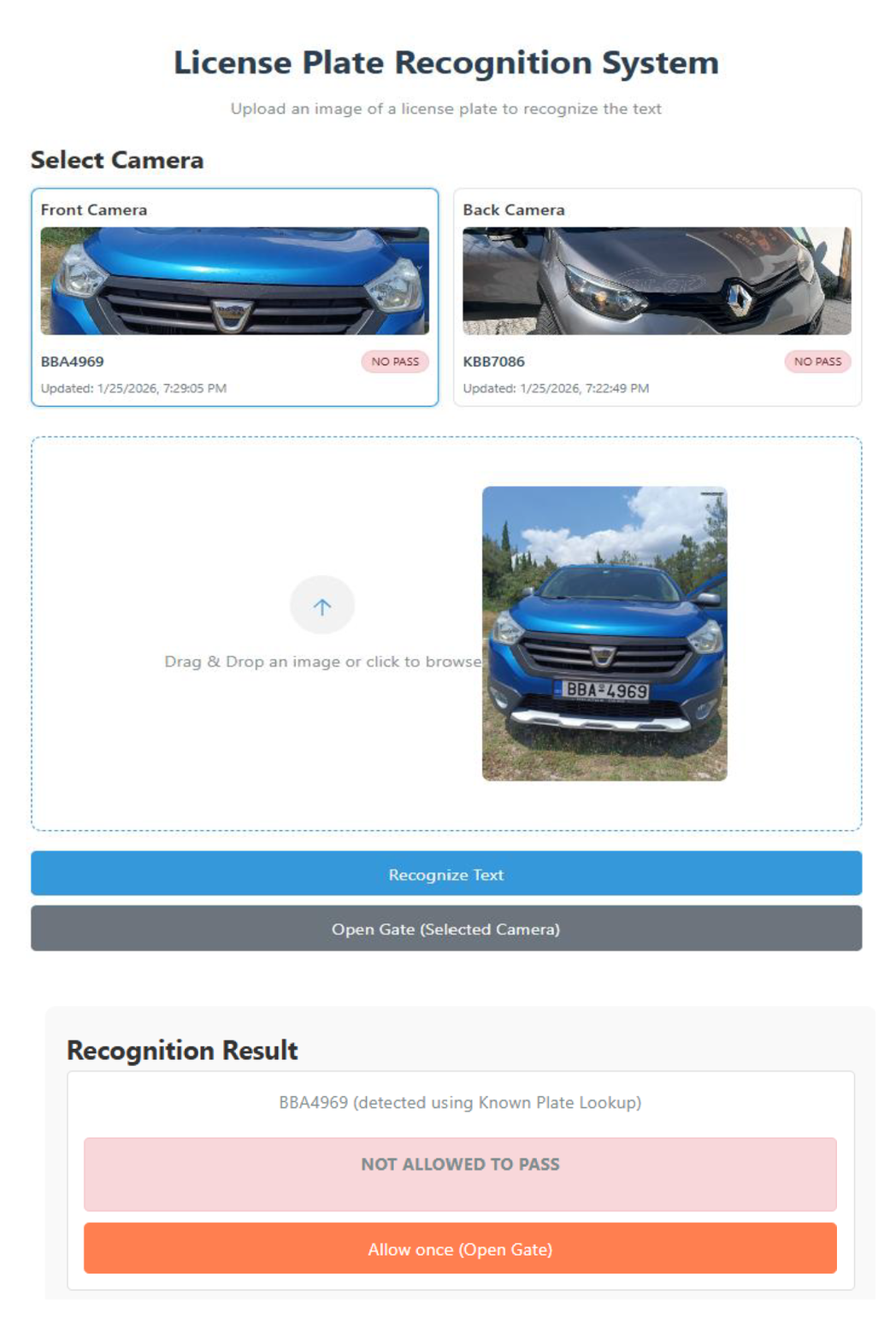
Key Features
- Automatic License Plate Recognition (ALPR) for vehicle identification
- Automatic authorization of registered vehicles and access control decisions
- Automatic and manual gate opening
- Support for temporary access overrides for unauthorized vehicles
- Real-time monitoring of vehicle entries and exits
- Management of authorized vehicles and license plates
- Parking occupancy and traffic statistics
- Real-time visualization of vehicles currently inside the parking area
Technologies: Python · Flask · ALPR · YOLO · ONNX · PostgreSQL · REST API · Server-Sent Events · Docker · Nginx · IoT
Developer: Achilleas Petridis · 2026
SmartCampus BI & Recommendation Report
SmartCampus BI & Recommendation Report is a data-driven analytics and recommendation platform for Smart Campus management. The system combines environmental IoT telemetry with teaching schedules to analyze classroom conditions, identify patterns and support operational decision-making through interactive visualizations and recommendations.
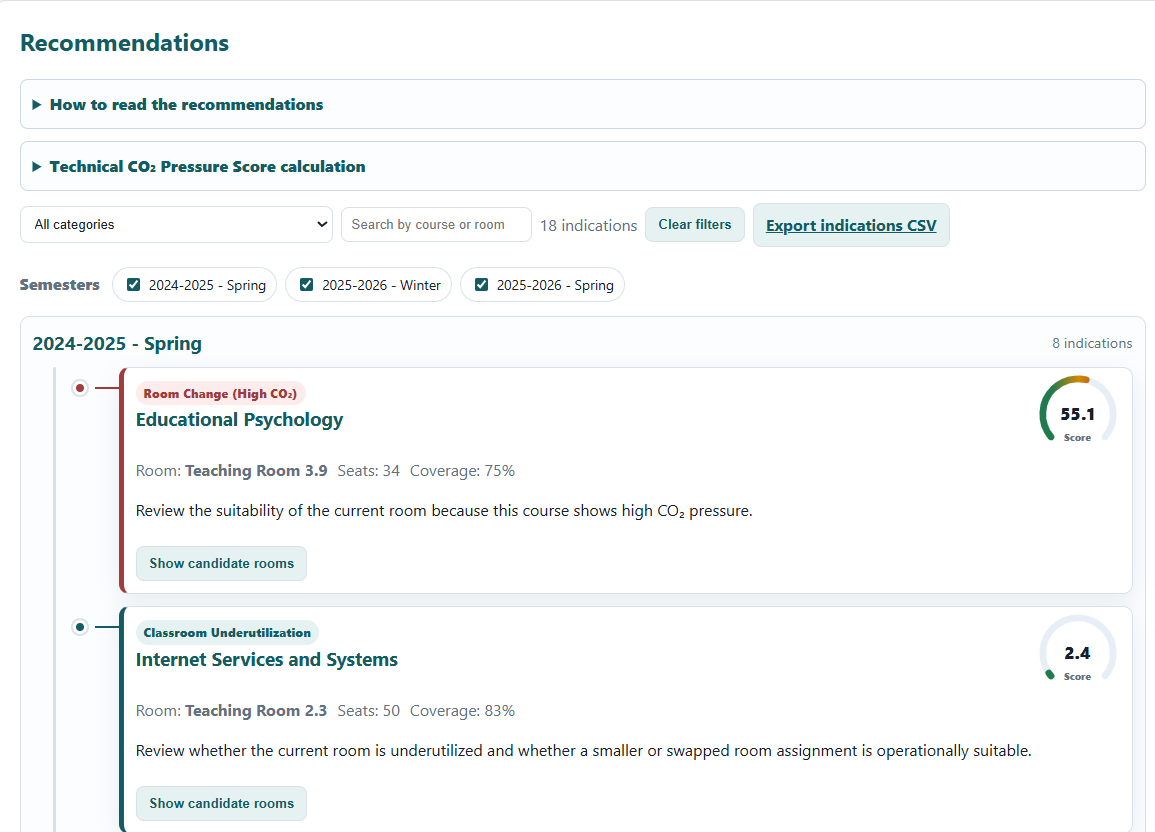
Interactive demo example for the Department of Informatics & Telematics
Key Features
- Analysis of environmental IoT data and classroom conditions
- Monitoring and analysis of CO₂ levels across rooms and courses
- Identification of temporal patterns and high-CO₂ conditions
- Data-driven recommendations for room allocation and ventilation
- Analysis of classroom utilization and underutilization
- Interactive room and course exploration and comparison
- Integration of environmental telemetry with teaching schedules
- Web-based interactive analytics and recommendation dashboard
Technologies: IoT · Data Analytics · Business Intelligence · Recommendation Systems · Data Visualization · Smart Campus · CO₂ Monitoring
Developer: Antonios Rouseas · 2026
Vehicular Network Simulation in MATLAB
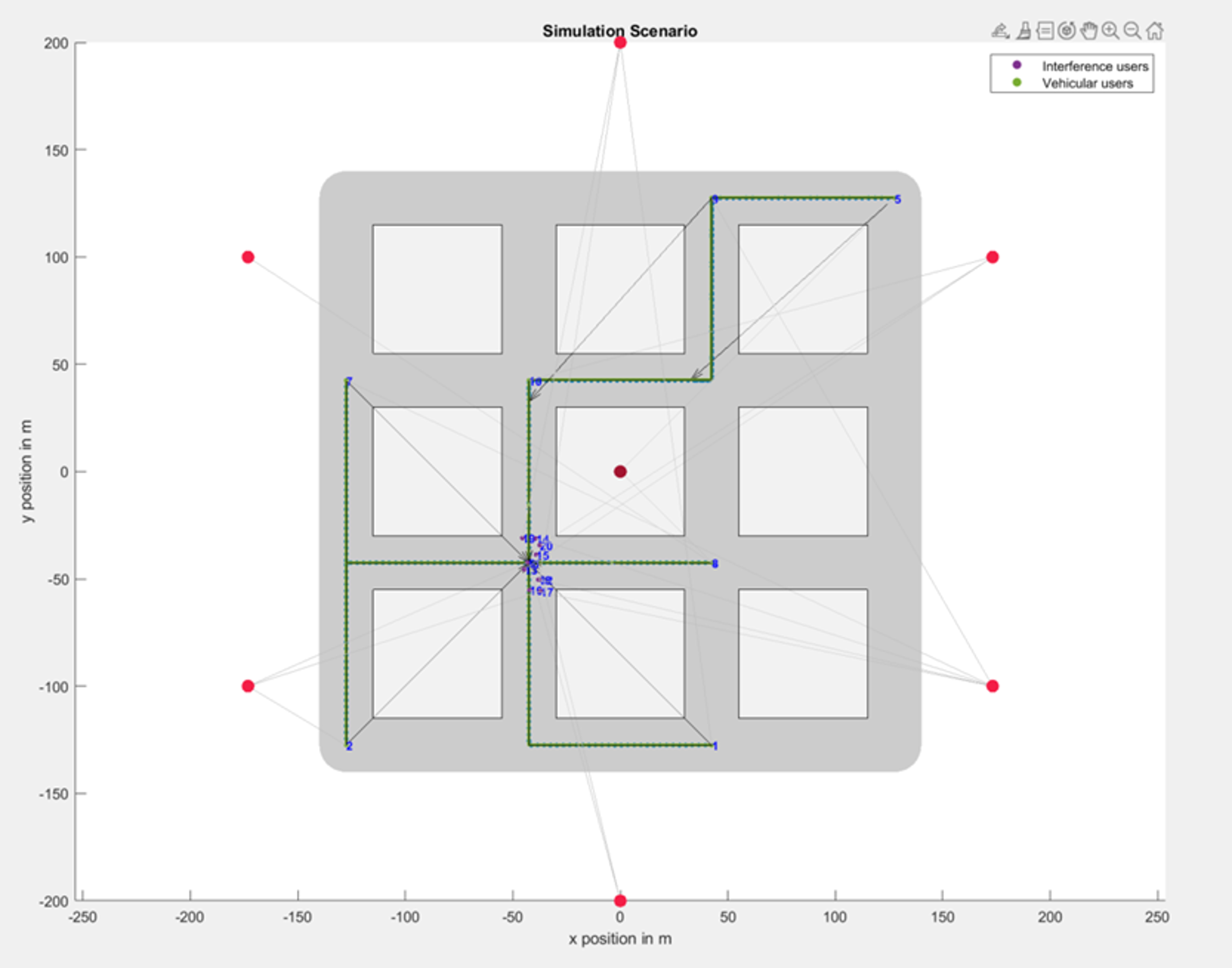
Vehicular Network Simulation is a MATLAB-based simulation environment for modelling and evaluating mobile vehicular users in an urban 5G network. The implementation extends the Vienna 5G System Level Simulator with a vehicle mobility model and a realistic Manhattan Grid scenario, enabling the study of network behaviour and Quality of Service under dynamic vehicular conditions.
Key Features
- Urban vehicular network simulation using a Manhattan Grid environment
- Vehicle mobility modelling within the Vienna 5G System Level Simulator
- Dynamic movement of vehicular users along the urban road network
- Simulation of base stations, vehicular users and interference users
- Realistic representation of buildings and urban network topology
- Evaluation of network performance under dynamic vehicular mobility
- Collection and visualisation of QoS metrics including throughput, latency, SINR and block error rate
Technologies: MATLAB · Vienna 5G System Level Simulator · Object-Oriented Programming · Vehicular Networks · 5G · Network Simulation
Developer: Orestis Kritsotakis · 2025
MS-VAN3T Simulator Enhancement for V2X Traffic Management
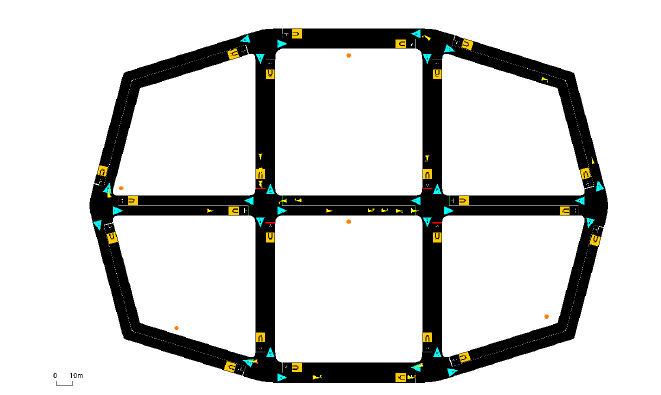
MS-VAN3T Simulator Enhancement extends the existing MS-VAN3T vehicular network simulation framework with enhanced functionality for realistic V2X traffic-management scenarios. The implementation enriches the interaction between vehicular communications and traffic behavior, combining SUMO-based mobility with the ns-3 networking environment.
Key Features
- Enhancement of the existing MS-VAN3T vehicular network simulation framework
- Extended support for realistic V2X traffic-management scenarios
- Adaptive interaction between vehicular communications and traffic behavior
- Vehicle state and traffic-condition monitoring within the simulation environment
- Integration of SUMO vehicle mobility with the ns-3 communication environment
- Support for multiple vehicular communication technologies
- Realistic modeling of connected vehicles and road infrastructure
- Flexible environment for experimenting with intelligent transportation scenarios
Technologies: MS-VAN3T · NS-3 · SUMO · C++ · TraCI · V2X · IEEE 802.11p · C-V2X · NR-V2X · Vehicular Networks
Developer: Klara Doçej · 2025
P2P BitTorrent Network Simulation
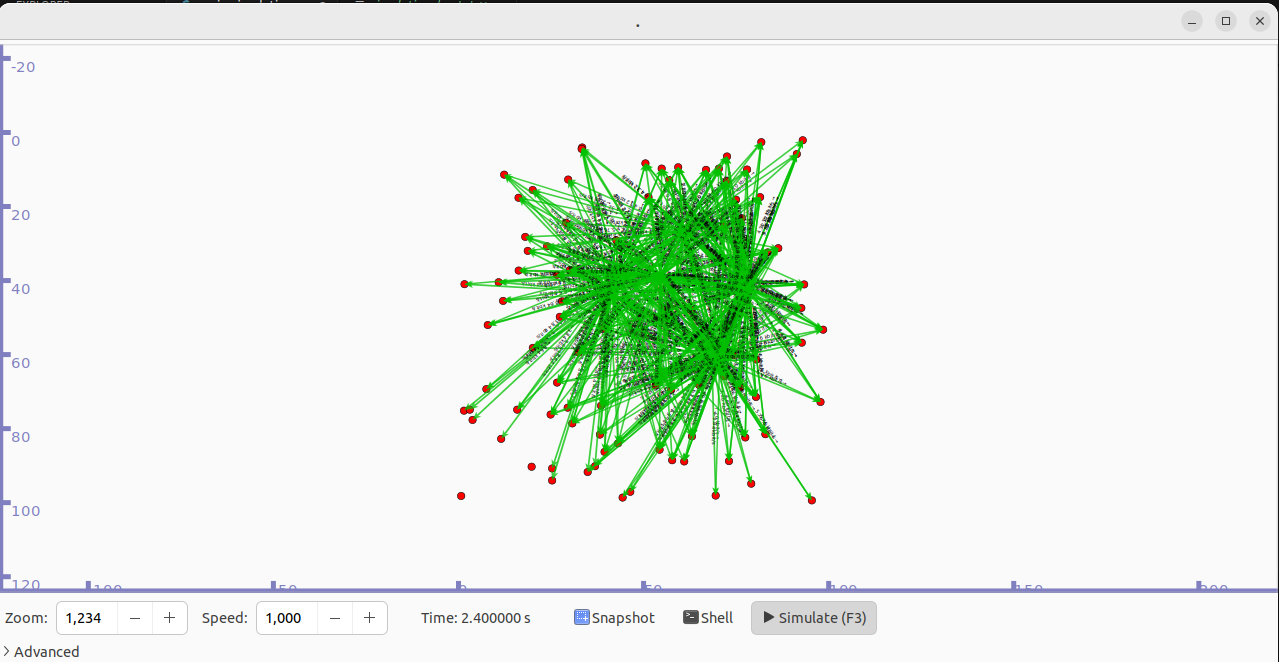
P2P BitTorrent Network Simulation is an NS-3-based simulation environment for studying peer-to-peer file distribution using a simplified BitTorrent model. The system models seeders, leechers, a central tracker, file-piece distribution and peer mobility, enabling experimentation with different network configurations and analysis of their impact on file distribution performance.
Key Features
- Simulation of peer-to-peer file distribution using a simplified BitTorrent model
- Seeder, leecher and tracker-based network architecture
- File segmentation and piece-based distribution between peers
- Dynamic peer mobility and changing neighborhood relationships
- WiFi-based communication using real UDP packet transmissions
- Configurable number of peers, neighbors, file pieces and piece sizes
- Real-time visualization of moving peers and network connections using PyViz
- Performance analysis based on completion time, throughput, upload/download ratios and peer fairness
Technologies: NS-3 · C++ · BitTorrent · Peer-to-Peer Networking · WiFi · UDP · PyViz · Network Simulation · Performance Analysis
Developer: Alkinoos Georgis · 2025
Contact
-
Address:
Harokopio University of Athens
School of Digital Technology
Department of Informatics and Telematics
9, Omirou Str., 177 78, Tavros, Athens, Greece
E-mail: eliotou@hua.gr
Department of Informatics and Telematics
Harokopio University of Athens
Intelligent Computer Systems and Applications